Branding
Product design

Visual design
UX research
Interaction design
From generic to genuinely meaningful recognition
At a glance
The product team was exploring a recognition feature with no validated foundation, only a preliminary set of assumptions.
I led the research end-to-end, designing activities to uncover what makes recognition meaningful, with those insights shaping the final feature design.
Recognition became one of the most widely used features in the product, with site analytics from one customer showing an 18.5% user interaction rate, growing over 12% since launch.
OPPORTUNITY
A starting point built on assumptions
The product team was exploring the opportunity to introduce an employee recognition feature, but beyond a preliminary set of assumptions there was no validated foundation to build from. They needed to understand not just whether those assumptions were right, but which aspects of recognition mattered most to employees. I was asked to lead the research effort with minimal direction while also mentoring a co-op student, and part of the work was figuring out what questions to even ask.
PROCESS
Defining the research goals
To give the work direction, I started by defining clear research goals that would guide what we were trying to learn and how we'd approach the research.
Validate and prioritize what we know
Test existing assumptions and uncover gaps in our understanding of employee recognition.
Define what makes recognition meaningful
Explore what makes recognition feel valuable and impactful from an employee perspective.
Understand recognition in context
Explore how recognition happens across different workplace experiences as a giver, receiver, and observer.
Designing research activities to uncover what makes recognition meaningful
With the research goals in mind, I designed and facilitated two research activities in Miro to understand what employees value most in workplace recognition.

Prioritization exercise
Participants ranked motivations for giving, receiving and seeing recognition, helping validate existing assumptions while revealing what employees value most.

Journey mapping
Participants mapped the before, during and after moments of a recognition experience, capturing actions, thoughts and emotions at each stage.
KEY INSIGHTS
What employees told us about recognition
The research activities surfaced four key insights that directly shaped how the feature was designed:
When giving and receiving recognition, participants most valued specific praise that explained what someone did and why it mattered. Generic recognition often felt impersonal or less genuine.
When observing recognition given to others, participants wanted more context around why someone was being recognized. Without that context, the recognition could feel vague or disconnected.
Participants had different comfort levels with receiving public recognition. Many shared that the most meaningful recognition often came from peers in smaller, more personal settings.
Participants viewed recognition as more than individual appreciation. Celebrating contributions fostered gratitude, strengthened connections between colleagues, and reinforced the organization's purpose and values.
SOLUTION
Finding the right visual direction
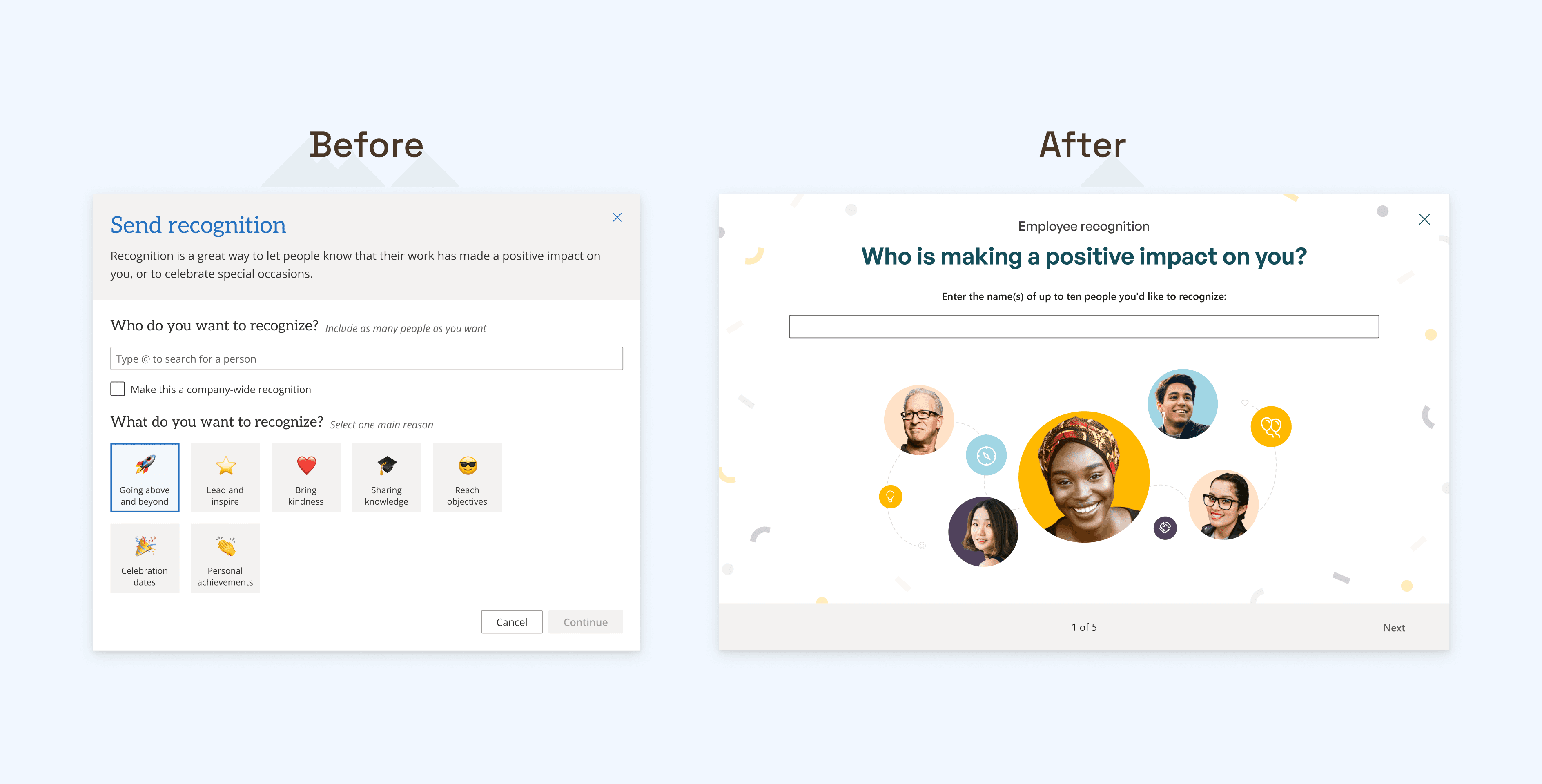
After completing the research I continued to contribute beyond my original scope, helping shape the visual and interaction design of the feature. I believed that recognition should feel celebratory and human, so I looked for UI patterns that leaned into people imagery, bold use of colour and a visual energy that made the feature feel like a genuine moment of celebration.

A more celebratory direction
The initial design was functional but didn't capture the celebratory and human feeling our research showed employees valued. By bringing in people imagery, bolder colour and a more expressive visual treatment, the feature started to feel like a genuine moment of recognition.
Designing with the insights in mind
The insights directly informed the decisions made in designing the recognition experience.

Discouraging generic recognition
Limits on how many people can be included in a single post encourage employees to recognize individuals or small groups rather than large, impersonal acknowledgements.

Encouraging specific praise
The experience prompts employees to select up to three reasons for recognizing a colleague, with categories organizations can configure to reflect their company values. A text field lets employees describe the impact in their own words.

Supporting different preferences
Recognition can be shared publicly or privately, ensuring the experience feels meaningful regardless of personal comfort level.

Reinforcing a culture of gratitude
Employees receive immediate acknowledgement after recognizing a colleague, reinforcing that every act of recognition contributes to a culture of appreciation and encourages continued participation.
Recognizing an opportunity to build for every client
Shortly after the feature launched, one of our clients, Corus Entertainment, presented a new opportunity to build on it further as they planned their own intranet. They wanted to increase the visibility of recognition and create more opportunities for employees to engage with it. I was part of the research team running listening labs with Corus employees, and two insights stood out: people valued printing a physical certificate to display at their desk, and managers wanted to be notified when their direct reports were recognized.
I led the design of both additions, a customizable, downloadable certificate and a manager notification experience, and advocated for their value beyond this one engagement. We prioritized them on the broader product roadmap, making them available to every client using the platform.

OUTCOME
From research insights to real-world impact
Since launching on Corus Entertainment's intranet, 18.5% of users have interacted with the recognition feature, growing over 12% since launch. The feature validated two key research insights: expanding recognition to support richer, values-based praise made appreciation more meaningful, while making recognition visible on the home page fostered a stronger culture of gratitude across teams.

The feature has since become one of the most widely used across the product, helping organizations foster a culture of recognition where employees feel valued for their contributions and connected to the people they work with.